Archived newsletter — Summer 2025. This issue preserves historical information; events, contacts, and resources may have changed.
Welcome to the 47th issue of the SIGnetwork Newsletter published for SPDG projects and their partners to learn about upcoming events, the latest relevant research, TA resources and training, and, most importantly, SPDG impact. We’re glad you're here!
Interested in reading past issues? Browse the Newsletter Archive. Was this email forwarded to you? Subscribe here.
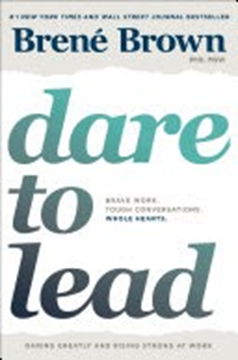
Our Book Club book, Dare to Lead, will be the next book we delve into with the SIGnetwork Newsletter. In my estimation, Brenѐ Brown has written a seminal guide to living and leading and has made a leadership assessment, videos and a workbook freely available on the Dare to Lead hub.
The next few newsletters will feature daring leadership ideas that resonated with the Book Club. In the meantime, here is the concept that has been most useful to me:
News You Can Use
New OSEP Fast Fact! Students Served under IDEA Part B Exiting School.
This is the first OSEP Fast Fact to focus specifically on how students with disabilities, ages 14-21, exit school—through graduation, dropout, reaching maximum age, and other exit reasons.
This new OSEP Fast Fact uses data from the IDEA Section 618 Part B Exiting Data Collection to provide a national snapshot of the educational outcomes for students with disabilities as they transition out of school.
Highlights from the 2025 OSEP Fast Facts: Part B Exiting School:
In the US, Outlying Areas, and Freely Associated States for School Year 2022-23:
- 75.85% of students with disabilities, ages 14-21, who exited school graduated with a regular high school diploma.
- 13.9% of students with disabilities, ages 14-21, who exited school dropped out.
- 8.4% of students with disabilities, ages 14-21, who exited school graduated with a certificate.
- 8 States reported students with disabilities, ages 14-21, who graduated with an alternate diploma. ESSA allowed states to create a state-defined alternative diploma for students with significant cognitive disabilities who participate in alternate assessments.
- The visualizations show important patterns across states and disability categories, offering insights into where progress is being made and where challenges remain.
This OSEP Fast Fact marks an important step in expanding our understanding of how students with disabilities complete their educational journeys. By shining a spotlight on exiting outcomes, OSEP aims to support efforts that improve post-school success for all students.
SPDG Success
The Alabama SPDG supports reading and math for children with disabilities through a multi-tier system of support (MTSS). They share their impact through data and through stories, such as these:
- “One example of reading impact is a fourth-grade student in a high-poverty school. At the beginning of the school year, she struggled with reading fluency and lacked confidence in her ability to read. She did not receive any intense intervention until after her teacher attended AL-SPDG training. The teacher began implementing oral reading interventions and providing one-on-one support, and since then, the student’s word count per minute increased by over 30 words in a five-week span.”
- “One example of postsecondary transition success is a middle school student with Autism in another high-poverty school district. The district had not offered secondary transition supports at a middle school level, but as part of the AL-SPDG, the district was able to leverage funds to develop a school-based work program at the middle school level. The program involved raising chicks, and the student thrived learning the fundamentals of animal care. After her school-based experience, and with assistance from her teacher and family, she started her own pet grooming business. The business has been successful, and she will continue to work as she moves to high school.”
OSEP Conference & SPDG National Meeting
SPDG @ the OSEP Conference:
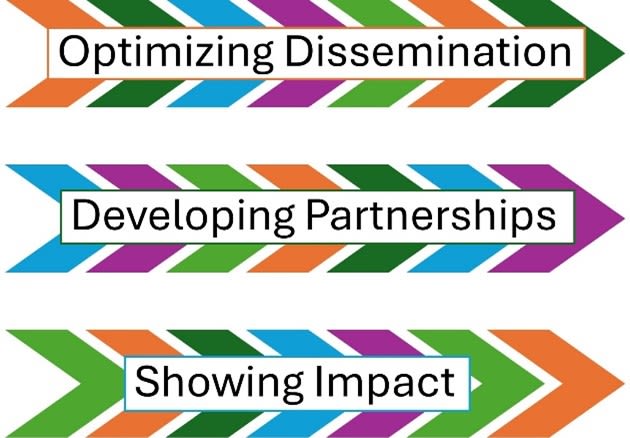
- 1st Day (all day): Scavenger Hunt. Gather information on dissemination, partnerships, and impact.
- 1st Day (6-7:30): SPDG Social. Bowling! with old friends and making new ones. Lucky Strike Arlington.
- 2nd Day (11:30-12:45): SPDG Program Area Meeting - Strategize partnerships to further your project.
Note: If you are not attending the conference, please complete the Scavenger Hunt and complete Steps 1 and 2 of the Dissemination Workbook. More information about timelines can be found here. If you are interested in watching the two webinars referenced in the Dissemination Workbook, you can find them on this page.
Key Dates for You and Your Team
- August 5 (Prior to): Dissemination Workbook Step 1: Complete with your SPDG team.
- August 6 (CoB): Workbook Step 2 draft.
- September 1: Workbook Step 3 draft.
- September 30: Workbook Step 4 draft.
- October 14: Workbook Step 5 draft.
- October 15 & 16: Complete Workbook: Finalize your dissemination plan during the 2025 SPDG National Meeting (virtual).
Coaching Series Update

Our latest Coaching Series webinar, “Identifying Sources of Data for Measuring Coach Efforts and Effects” gave us tools to collect data that reflect both the quantity and quality of coaching efforts.
Coaching Resources
- Participant Handout_PBC-DIDM_SPDG Project Directors Webinar_July2025.pdf
- Slide Notes_PBC-DIDM_SPDG Project Directors Webinar_July2025.pdf
- PBC-DIDM_PBC_Coaching_Log_v2.0_Accessible_Fillable.pdf
Improving Professional Learning
Effects of Online Tiered Training to Increase Teachers’ Use of Positive Behavior Supports. Teacher Education and Special Education, research article.
Tiered Training Frameworks
“One training approach that aims to use resources efficiently and individualize teacher support is tiered training (Bloomfield et al., 2024). Tiered training frameworks mimic multi-tiered systems of support for students and are resource-efficient because resource-intensive training procedures (e.g., coaching) are only provided to teachers who need it.”
Torelli, J. N., Miller, A. H., Granger, K. L., Noel, C. R., & Gross, T. J. (2024). Effects of Online Tiered Training to Increase Teachers’ Use of Positive Behavior Supports. Teacher Education and Special Education, 47(4), 302-318.
Defining Curriculum-Based Professional Learning: Building a Common Language
Research Partnership for Professional Learning (RPPL), April 2025
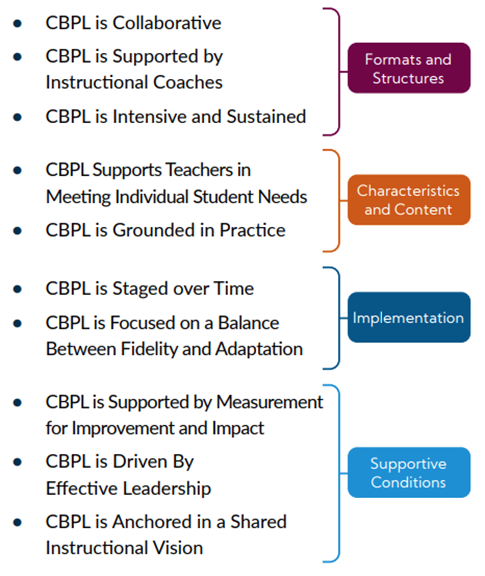
Across the research literature and RPPL’s organizational resources they found 10 qualities critical to curriculum-based professional learning (CBPL):
Building Trusting Relationships to Support Implementation and Evidence Use
Webinar with Dr. Allison Metz

Research article: Building trusting relationships in teams to support evidence use and implementation in human services: feasibility and acceptability of a training and coaching approach
Family Engagement Done Well
Family Engagement in Action: A Roadmap for Building Authentic School-Family Partnerships that Boost Student Learning
Report (original link unavailable in this archive), February 2025
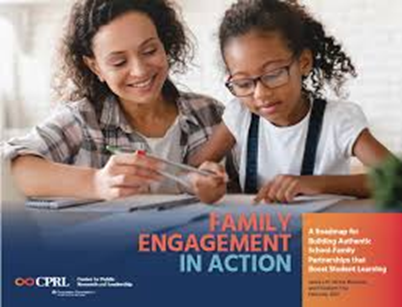
Developed through Carnegie Corporation of New York, this report draws on a two-year collaboration between 10 grantee organizations and the Center for Public Research and Leadership at Columbia University. Together, they explored strategies to make family engagement a central part of student learning and well-being, rather than an add-on.
Spotlight on TA & Technology
Universal TA
SISEP Technical Assistance Series: Universal TA webinar
Brief: Universal TA
With the many resources available on the Active Implementation Hub, Active Implementation Learner Pathways and Implementation Support Practitioner Core Competencies Learner Pathway are accessible to support a universal TA recipient’s engagement with learning activities and resources.
Each Learner Pathway provides a detailed sequence of learning lessons, tools, and experiential learning activities to support a recipient in progressively gaining the necessary knowledge, skills, and competencies to implement evidence-based practices in real-world settings.
Evaluators' Corner
A good infographic can have more impact than a 100-page evaluation. For example:
The Illinois SPDG supports new special education teachers. Specifically, they teach them how to write and implement quality IEPs, manage their classroom well, and use evidence-based reading and math strategies. In the schools served by the project, 97% of special education teachers remained in special education teaching in Illinois. 90% of special education teachers in SPDG-supported districts remained, whereas districts not supported by the SPDG only retained 80%, a 10% difference. The project also increased the number of special education teachers with full licensure from 484 to 712.
The project created an infographic sharing these highlights and more.
1. Those overseeing professional learning should receive training on the importance of:
- operationally defined independent variables
- training manuals
- explicit implementation
2. Efforts need to be made to increase the acceptability and contextual fit of a new intervention (Detrich, 2014).
- Involve school staff in making decisions about interventions or procedures for implementation.
- Professional development be explicit and evidence based, and that it include ongoing coaching support.
- Implementers should receive feedback that ideally is visual and provides suggestions for increasing or decreasing specific behaviors (Ennis et al., 2018).
Tweets/Podcasts/Videos
LinkedIn Post of the Month
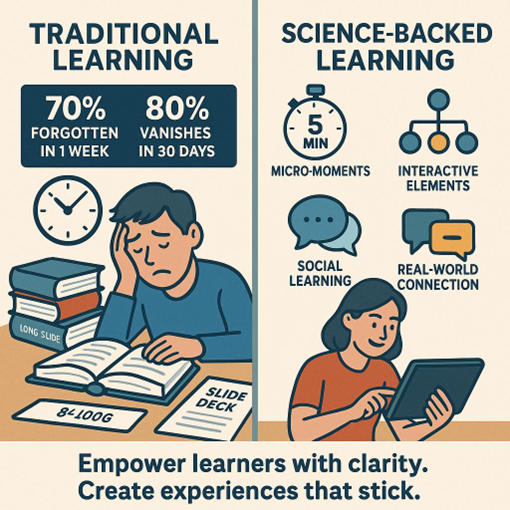
Eliana Tardio and Andrew Whatley have something to say about how micro-moments can improve training and learning. (LinkedIn post)
If You Have a Minute
This Intervention Cut Course Failures by a Third. How It Works
By Caitlynn Peetz — June 24, 2025 4 min read
EducationWeek
“In 2023, dozens of schools piloted retooled, relationship-centered strategies for supporting students as part of a program through the GRAD Partnership, a coalition of 12 organizations that partner with schools to carry out the implementation of student-success systems.
Schools saw significant improvements in students’ absenteeism and course failure rates after two years working intentionally building robust student success systems that get at-risk students back on track early, according to a new report that analyzes data from more than 50 schools.
Participating schools saw a 32% drop in course failures and a 28% decrease in chronic absenteeism, according to the report.”
Are Early-Reading Laws Changing Teaching Practices?
“An ongoing Education Week tracker shows that while 40 states have passed new laws about the science of reading, they have different emphases. Far more include that include professional development on reading than on preservice teacher preparation.
For the study, RAND researchers analyzed a nationally representative sample of more than 1,800 K-5 elementary teachers in spring 2024, asking them about their background, the techniques for teaching reading they use, and their use of curriculum materials. The findings suggests those laws have reshaped teaching—but only in fits and starts.
On the one hand, teachers with fewer than five years’ experience were more likely than those with more experience to say they’d had preservice preparation aligned with the science of reading, suggesting some preservice training has begun to change with regard to foundational reading skills. These less experienced teachers also were more likely than teachers with more experience to use evidence-based classroom materials.
But only a dozen states and the District of Columbia have passed more comprehensive reading laws that require teachers to use new curricular materials—in addition to pre- and in-service training.
Shapiro and her colleagues found that nearly 75 percent of K–2 teachers and 66 percent of teachers of grades 3-5 received professional training on how to teach foundational reading skills in the 2023–24 school year.