Archived newsletter — Fall 2024. This issue preserves historical information; events, contacts, and resources may have changed.
Welcome to the 43rd issue of the SIGnetwork Newsletter published for SPDG projects and their partners to learn about upcoming events, the latest relevant research, TA resources and training, and, most importantly, SPDG impact. We’re glad you're here!
Interested in reading past issues? Browse the Newsletter Archive. Was this email forwarded to you? Subscribe here.
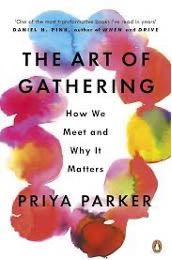
We are continuing our series exploring Priya Parker’s ideas from The Art of Gathering. The first chapter, DECIDE WHY YOU’RE REALLY GATHERING, is all about getting clear on the purpose of the event and ensuring each aspect is geared toward reaching that purpose. The second chapter, CLOSE DOORS, describes why opening the event to any interested party may prevent you from fulfilling the event’s purpose. Last month we discussed why Parker recommends DON’T BE A CHILL HOST. Then we explored how to CREATE A TEMPORARY ALTERNATIVE WORLD. Then we learned why we should NEVER START A FUNERAL WITH LOGISTICS. Now we get to consider why you should KEEP YOUR BEST SELF OUT OF MY GATHERING.
The timing is perfect for us to consider the importance of vulnerability when we meet as groups, because our Book Club is studying “Dare to Lead” by Brene Brown. Dr. Brown is a well-known researcher, author, and speaker who studies shame, vulnerability, and what makes an organization healthy and successful. She has found that a significant feature of healthy organizations is that people feel safe enough to share their “real” selves. In other words, people feel sufficiently psychologically safe to be vulnerable with the people they are working with.
In the Art of Gathering chapter KEEP YOUR BEST SELF OUT OF MY GATHERING Priya Parker talks about her experience at a large, well-respected conference, “The conversations I was part of often remained superficially intellectual, with little realness or emotional risk. It was like many conferences I have attended: you go, try to impress people with how smart you are, perhaps come away with a few new work opportunities. But it was difficult to have any authentic engagement.”
If I could choose a term to define SIGnetwork I would pick “authentic engagement.” The courage people show by sharing their work and delving into their challenges with others is inspirational. Additionally, the level of mentoring I observe could only be made possible by folks being vulnerable with each other (and giving their precious time!). We are delving into these ideas in the SIGnetwork Book Club (email Jennifer.Coffey@ed.gov to join).
As we look back on the SPDG National Meeting held October 15-16, I hope you feel prepared to share your real self and receive the authenticity others share. A quote from a respondent to the SPDG Program Area Meeting post-event survey says it all:
I am a very structured, linear person and always get a bit nervous when I don’t know all the exact details of how this is going to go. However, after being with the SPDG for four years, I have grown to absolutely LOVE the looser structure of these meetings. It allows relationship and vulnerability, which has contributed so much to my growth. Thank you!!!
-Jennifer
News You Can Use
2024 SPDG National Meeting

The SPDG National Meeting was October 15-16 in DC “EmpowerED: Elevating Voices, Enriching Education, Embracing Collaboration; The Adventure Starts Here.”
- Find SPDG projects’ infographics and impact stories here.
- Kevin Johnstun’s AI Keynote a hit! Now what?
The Department’s Office of Educational Technology (OET) released “Empowering Education Leaders: A Toolkit for Safe, Ethical, and Equitable AI Integration,” a new resource designed to support school leaders as they plan to leverage Artificial Intelligence’s benefits for teaching and learning while managing its risks (Homeroom blog). This toolkit helps educational leaders ensure safe, ethical, and equitable use of AI in schools, districts, and education communities.
Next SPDG Directors’ Webinar
We heard you loud and clear, you wanted to participate in sessions you weren’t able to go to because you have breakout session FOMO, something I can relate to.
Our December Directors’ Webinar will feature breakouts from SPDG National Meeting presenters. Be ready to ask hard questions and figure out how you will use the strategy/tool they’re sharing.
SPDG Success!

Tennessee SPDG
Initial findings demonstrate professional development may be leading to increased inclusion and improved outcomes for students with disabilities.
Coaching data shows that special education teachers are actively engaged in coaching cycles. Initial coaching data indicates that teachers find the coaching useful and effective, with teachers already showing fidelity in identifying student communication barriers and opportunities. Coaching notes show promising outcomes for students as evidenced by increased inclusion across the school environment and throughout the school day, an increase in student enrollment in classes with their nondisabled peers, and an increase in students accessing work-based learning opportunities.
Improving Professional Learning
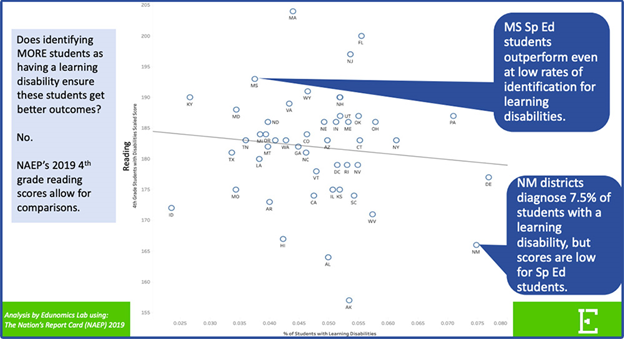
Researchers: Higher Special Education Funding Not Tied to Better Outcomes
The 74
Beth Hawkins, August 2024
Early look at state-by-state spending on special ed reveals scattershot efforts, suggests evidence-backed reading instruction for all kids is crucial.
From RPPL, The Research Partnership for Professional Learning:
Read - AI in Professional Learning: Navigating Opportunities and Challenges for Educators
The use of artificial intelligence (AI) in the classroom is widely discussed, yet there has been far less attention to the ways that AI will change teachers’ learning experiences.
Listen – Podcast episode: No Such Thing: Education in the Digital Age - Setting the Course For Research on AI in Professional Learning
Use - A Checklist for Fostering Effective and Safe Integration of AI within PL Environments
Family Engagement Done Well
The Pennsylvania SPDG has created an engaging and welcoming video to give background information and let people know how they can participate in Families to the Maxx.
ICTQ Family Engagement Level 1
The Indiana Center on Teacher Quality’s (ICTQ), which provides professional development for the Indiana SPDG, has a self-paced course designed to introduce you to the main concepts and skills that teachers use when building strong, trusting partnerships with families.
Self-paced, fully online course via Canvas
Spotlight on TA & Technology
The US Department of Education Presents
Blending and Braiding: How to Make it Easier to Use Different Funding Streams to Meet the Needs of the Whole Child Webinar Series
Part 3: Strategies for Coordinating Services Across State and Local Agencies and Partners (November 14)
Shining the spotlight on the CEEDAR Center with a literacy tool and information about residencies and teacher apprenticeship programs:
Evidence-Based Reading Instruction for Grades K-5 IC
Reading proficiency is linked to academic, social, and economic outcomes. Check out our newest IC for the latest research on reading development and its application to instruction!
New RTAP Database and Resources
Check out CEEDAR’s new Registered Teacher Apprenticeship Program (RTAP) Database! This database provides high-level information on RTAPs leading to special education licensure in the US. View the database and other great RTAP resources here
Evaluators' Corner
Matthew Kraft et. al, “The Scaling Dynamics and Causal Effects of a District-Operated Tutoring Program”
This working paper highlights the ways in which staffing and scheduling constraints become far more noticeable as programs become larger and more widespread. Best-practice design features for small-scale tutoring programs may not be feasible or optimal for programs operating on a larger scale. Also, the paper considers tradeoffs between intensity and spread of the intervention.
Kraft, Matthew A., Danielle Sanderson Edwards, and Marisa Cannata. (2024). The Scaling Dynamics and Causal Effects of a District-Operated Tutoring Program. (EdWorkingPaper: 24-1030). Retrieved from Annenberg Institute at Brown University: https://doi.org/10.26300/zcw7-4547
Tweets/Podcasts/Videos
The Heart of Daring Leadership
The Dare to Lead Podcast with Brené Brown
Whether or not you’re reading “Dare to Lead” with our SIGNetwork Book Club, I think you’ll get a lot out of this episode as Brené shares some of the big ideas from the book.
If You Have a Minute
Understanding Individualized Education Program (IEP) Goals at Scale
Working Paper from the Annenberg EdExchange
By Christopher Cleveland and Jessica Markham, July 2024
The authors categorized IEP goals into 10 subjects and 40 skills. They reviewed digital IEP records for an entire state to understand the variety of IEP goal subjects and skills prescribed to students with different disabilities. This work was conducted as part of a research-practice partnership between Boston University’s Wheelock Educational Policy Center (WEPC) and the Indiana Department of Education (IDOE).
A few insights from Cleveland and Markham…
Students in earlier grades, like pre-kindergarten, have the most goals on average across all disability categories. The number of goals declines across grades. Across all grades, students with language impairment have the fewest goals, while students with multiple disabilities or moderate intellectual disability have the most goals.
…our work provides insight for states to consider specialists' workloads and expertise by grade and allocate specialists to grade levels.
… we posit that utilizing state-wide data systems for IEPs offers a substantial opportunity to understand special education services at scale and over time. This can inform more proactive planning, training, staffing, retention, and implementation efforts at district and state levels.
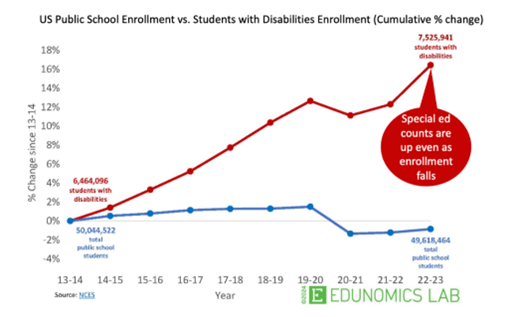
Special Ed is consuming a growing share of public school dollars. Is it helping?
A timely update from the Edunomics Lab at Georgetown’s McCourt School
More students are being referred to special ed, including for reading disabilities and ADD. The authors ask whether there is a subjective element to these diagnoses, especially given how much the rates vary across districts and states.
What they found:
Better reading instruction for all students was associated with better reading outcomes for students with learning disabilities.
Many kids can’t read, even in high school. Is the solution teaching reading in every class?
Some high schools and states are experimenting with ways to integrate literacy instruction across all classes
Article in Hechinger Report
By Julian Roberts-Grmela, August 2024
Jade Wexler, an OSEP grantee, is interviewed about secondary literacy teaching and interventions.
Highlights…
Between 2019 and 2022, more than 200 laws to reform reading instruction were enacted in 45 states and the District of Columbia, according to a report by the Albert Shanker Institute.
But, according to the report’s authors and other experts, legislation on reading reform is focused on early grades. Some experts and educators worry the reading reform movement has left older students behind.