Archived newsletter — March 2024. This issue preserves historical information; events, contacts, and resources may have changed.
Welcome to the 39th issue of the SIGnetwork Newsletter published monthly for SPDG projects and their partners to learn about upcoming events, the latest relevant research, TA resources and training, and, most importantly, SPDG impact. We’re glad you're here!
Interested in reading past issues? Browse the Newsletter Archive. Was this email forwarded to you? Subscribe here.
Reasons to Embrace Generous Exclusion
We are continuing our series exploring Priya Parker’s ideas in The Art of Gathering. The first chapter, Decide Why You’re Really Gathering, is all about getting clear on the purpose of the event and ensuring each aspect is geared toward reaching that purpose. The second chapter, Close Doors, describes why opening the event to any interested party may prevent you from fulfilling the event’s purpose.
Recently I’ve been helping others start communities and I’ve shared the wisdom behind “closing doors.” There are times when it’s meaningful to include only the people for which the topic or challenge matters most. When trying to accomplish something as a group, size matters. Roles and responsibilities matter. How will the group fulfill its purpose? If you want the group to work to solve problems, build something, or create true community, you likely want to have inclusion and thus exclusion criteria.
Parker describes the how and why of closing doors better than I ever could…. “Generous exclusion is the intentional drawing of a temporary line for the good of the guests and to help activate and fulfill a gathering's purpose.” An example from my work is the TA Center Dissemination Community of Practice.
When we began communicating about the new CoP, the center’ directors asked to join. The CoP facilitators explained why the true “communicators” should be the primary community members. We shared our plans to communicate progress and impact and ensure directors were kept in the loop. Our purpose for excluding directors was to create a role-alike community that enabled shared learning and improvement. Over time the group has developed a level of comfort that enables them to share challenges and questions related to the ever-changing world of communication (e.g., controversy and decisions related to Twitter/X, Tik Tok, AI).
Our April newsletter will explore why you should not be a Chill Host. By the end of the series, we hope you have at least 3 new ideas to try in virtual and in-person convenings. We do ask you share… how have Parker’s ideas helped to make your gatherings more meaningful? Email your thoughts to me and we will compile ideas to share with the group (Jennifer.Coffey@ed.gov).
-Jennifer
News You Can Use
- NASDSE-OSEP Webinar Series for potential SPDG applicants: Effective Professional Development Overview + Part C (March 6th from 3-4:00 ET on Teams)
Jennifer Coffey will share research findings that point the way to effective professional development (PD). She will also describe the components of SPDG Evidence-based Professional Development (EB-PD) and share an exemplar SPDG EB-PD worksheet.
Sunyoung Ahn will describe how to form strong partnerships between Part B and Part C and create an effective SPDG plan. She will also describe what makes a strong Comprehensive System of Personnel Development (CSPD). - Register and Reserve your Room for the OSEP Conference!

The SPDG program intends for states to improve results for children with disabilities. Across the program, state initiatives focus on a variety of outcomes among populations of students who have diverse needs and a large range of ages. However, the groups of children who are predominantly targeted by SPDG projects, past and current, are elementary-aged students with high-incidence disabilities.
From time to time, we receive questions about why more SPDGs do not serve children with significant disabilities, American Indian children, high schoolers, and infants and toddlers. We want to ensure we share examples of how SPDG funding can be used to serve these populations for current and future State efforts.
Please join us for our next Directors’ webinar, Thursday, March 7th from 3-4:30, which will provide examples of evidence-based efforts SPDGs can support that go beyond elementary students with mild to moderate disabilities.
Funding Opportunities
Family Engagement Model Demonstration Opportunities
Invitation for Applications: Model Demonstration Projects to Develop Equitable Family Engagement with Underserved Families of Children with Disabilities (Assistance Listing Number 84.326M)
The purpose of this priority is to fund 4 model demonstration projects. The models must implement sustainable, schoolwide policies, practices, and strategies that systemically engage underserved families of children with disabilities as partners and leaders in creating more equitable and inclusive schools that lead to improved outcomes for children with disabilities.
FY24 NIA 84.326M & 84.326M competition on Grants.gov
Deadline: April 24. Contact Carmen Sanchez with questions (Carmen.Sanchez@ed.gov)
School-based Mental Health Grants
Federal Register Notice
Contact Email: OESE.School.Mental.Health@ed.gov.
Purpose of Program:
The SBMH program provides competitive grants to State educational agencies (SEAs) (as defined in 20 U.S.C. 7801(30)), local educational agencies (LEAs) (as defined in 20 U.S.C. 7801(49), and consortia of LEAs to increase the number of credentialed (as defined in this document) school-based mental health services providers (as defined in 20 U.S.C. 7112(6)) providing mental health services to students in LEAs with demonstrated need
Deadline for Applications: April 30, 2024.
Pre-Application Webinar Information: https://oese.ed.gov/offices/office-of-formula-grants/safe-supportive-schools/school-based-mental-health-services-grant-program/
DOL Announces Apprenticeship Funding Opportunity
On February 21, 2024, the US Department of Labor announced nearly $200M available in grants to continue to expand Registered Apprenticeships. Included in this funding is (1) $95 million of competitive grants through a second round of Apprenticeship Building America (ABA2), and (2) $100 million for a second round of State Apprenticeship Expansion Formula grants (SAEF2).
1. ABA2
$95 million to expand, diversify, and strengthen the Registered Apprenticeship (RA) system through support for public/private partnerships designed to serve a range of industries and individuals and promote Registered Apprenticeship Programs (RAPs) as a workforce development solution that translates training into good jobs.
Applicants can apply for ABA2 grant funding under 3 categories:
Category 1: Ensuring Equitable RAP Pathways and Partnerships Through Pre-apprenticeship Leading to RAP Enrollment
Category 2: Creation of Education System-aligned Pre-apprenticeship Programs and RAPs; and
Category 3: Registered Apprenticeship Hubs.
Funding Opportunity Announcement (FOA) Link and Application Due Date:
The ABA2 FOA (FOA-ETA-24-04) is available at grants.gov, apprenticeship.gov, and dol.gov.
Applications due April 15, 2024.
Eligible Applicants:
Eligible applicants vary by grant category and applicants should refer to the FOA.
Have questions? For further information about this FOA, please contact Daniela Petchik at ABA2_FOA-ETA-24-04@dol.gov. Applicants should e-mail all technical questions to ABA2_FOA-ETA-24-04@dol.gov and must specifically reference FOA-ETA-24-04, and along with question(s), include a contact name, and phone number.
2. SAEF2
$100,000,000 in DOL funds are available for a second round of SAEF. The Department will award SAEF2 grants for Base Formula Funding to all States that apply. In addition to the Base Formula Funding, States with the capacity and readiness to adopt and expand RA in key innovation priority areas may apply for additional competitive funding. The SAEF2 grant program is intended to support State capacity in the development of new, and expansion of existing, RA programs, while also driving system innovation and reform.
Funding Opportunity Announcement (FOA) Link and Application Due Date:
The SAEF2 FOA (FOA-ETA-24-03) is available at grants.gov, apprenticeship.gov, and dol.gov.
The closing date for receipt of applications under this Announcement is April 4, 2024.
Eligible Applicants:
Eligible lead applicants are States. For the purposes of this FOA, the eligible 54 U.S. States and territories include all 50 States of the United States, District of Columbia, and territories whose Active Apprentices exceeds 100 apprentices, i.e., Guam, Puerto Rico, and American Samoa. Only territories with more than 100 registered apprentices (as of FY 23 data) are eligible to apply for Base and Competitive funds.
Frequently Asked Questions: Will be available on both the dol.gov and apprenticeship.gov pages by approximately March 8, 2024.
Contact Bria Wearren at SAEF2_FOA-ETA-24-03@dol.gov. Applicants should e-mail all technical questions to SAEF2_FOA-ETA-24-03@dol.gov and must specifically reference FOA-ETA-24-03, and along with question(s), include a contact name, and phone number.
SPDG Success!
The Arkansas SPDG has developed micro-credentials that provide educators with an equitable approach to professional learning on Universal Design for Learning (UDL), high-leverage practices (HLPs), and other evidence-based instructional practices. The overall goal is to ensure that every student has access to a high-quality, effective teacher. 100% of teachers who completed micro-credentials last year demonstrated increased self-efficacy for improving outcomes for all learners, including students with disabilities.
The Arkansas SPDG also measures the effect their professional learning opportunities have on reading scores for students with disabilities. The project exceeded the target of 61.50% of students with disabilities having moderate to high value-added scores (VAS). At SPDG schools 64.76% of SWD had moderate to high VAS.
Improving Professional Learning
Intentional Learning Goals Create the Potential for Transformational Change
By Learning Forward, Stephanie Hirsh & Tracy Crow — June 14, 2018
Educators need their own goals for improvement, and they (and their trainers and coaches) will benefit from addressing more than their knowledge and skills. If the professional learning (PL) participant doesn’t believe that the intervention can work (aspirations) or is unhappy to be part of the PL (attitudes) it is unlikely that even the best PL will have the desired impact.
In Assessing Impact: Evaluating Professional Learning, Joellen Killion (2008) introduced the KASAB model -- knowledge, attitudes, skills, aspirations, and behaviors. If teams consider these elements when creating and carrying out their training and coaching, they can optimize their efforts and help PL participants create better goals for their learning and improvement.
A Qualitative Synthesis of Research on Professional Learning for Multi-Tiered Systems of Support - Jose M. Castillo, Jennifer R. Wolgemuth, Meaghan McKenna, Rachael Hite, Joseph D. Latimer, 2024
The authors analyzed 46 studies of MTSS professional learning and implementation and stated that:
“Findings illuminated educators’ positive experiences with ongoing, job-embedded PL, particularly PL communities and coaching. Studies also illustrated the importance of collaboration and trust within learning communities as well as leaders who empower and trust educators.”
Sustainable State ESSER Investments in Literacy to Improve Student Performance
Paper from The Council of Chief State School Officers (CCSSO)
CCSSO hosted a national literacy summit in January 2020 and later published a report, A Nation of Readers: How State Chiefs Can Help Every Child Learn to Read, naming four recommended concrete actions that state leaders could take to improve student reading skills:
- Articulate a coherent vision for improving literacy grounded in evidence-based practices and a commitment to equity and student outcomes.
- Align state education agency (SEA) organization, staffing and practices to support reading as a foundational driver of equity and achievement.
- Provide policy guidance and support to districts and schools regarding aligning curricula, assessments and professional learning to the science of reading.
- Engage college and university partners to support the state reading strategy.
The current report provides examples of how States used ESSER dollars to:
- Create laws, guidance, and alignment to support the science of reading across the State.
- Support educator preparation programs to teach the science of reading.
- Provide professional learning on the science of reading with a focus on coaching.
- And deploy community college students and others to provide high-impact tutoring services.
Family Engagement Done Well
Family Engagement, Attendance, and Performance on Statewide Assessments in Kansas
This report outlines a recent analysis conducted by the Kansas Technical Assistance System Network (TASN) Evaluation Project, which explored correlations between family engagement and chronic absenteeism as well as between chronic absenteeism and student performance on statewide assessments. Findings revealed that there is a significant inverse correlation between family engagement and chronic absenteeism as well as between chronic absenteeism and student achievement on statewide assessments. These findings highlight the importance of utilizing family engagement strategies to improve student attendance and achievement.
New Release: Family Engagement Learning Series Briefs

The U.S. Department of Education (Department) recently released the Family Engagement Learning Series briefs! These briefs summarize a six-part webinar series of conversations designed to Raise the Bar for family engagement practices between school and home. The 2023 series, produced by the Department in partnership with Carnegie Corporation of New York and Overdeck Family Foundation, provided an overview of evidence, highlighted bright spots in the field, and shared resources and evidence-based strategies to support student success with education leaders and practitioners.
Spotlight on OSEP and ED-funded TA & Technology
Created By: Michael Kennedy - mjk3p@virginia.edu, Rachel Kunemund - rk8vm@virginia.edu. Interested in Coached? Contact Us
Created By: Michael Kennedy - mjk3p@virginia.edu, Rachel Kunemund - rk8vm@virginia.edu. Interested in Coached? Contact Us
COACHED 2.0 Intro Video on Vimeo
The COACHED web app (Capturing Observations and Collaboratively sharing Educational Data) offers a suite of evidence-based coaching tools and professional learning materials.
COACHED contains four core elements:
- The Classroom Teaching (CT) Scan observation tool and accompanying data-driven outputs (https://coachedweb.azurewebsites.net/);
- A customizable feedback template that automatically populates using observation data captured using the CT Scan;
- A dashboard that allows stakeholders to access data, coaching reports, and personalized goals; and
- A library of multimedia vignettes teachers and others can watch to receive just in time professional development about practices where improvement may be needed (see www.spedintro.com for samples).
The COACHED suite, in the hands of a skilled coach, administrator, teacher educator, or teacher (pre- or in-service) who is self-reflecting, can illuminate the quality and quantity with which specific practices are being implemented, and provide a clear and sustainable mechanism for making needed improvements.
Evaluators' Corner
Actionable data: Turning Subjective Goals to Concrete Outcomes
"Deep learning, often called transformational learning, occurs at the level of beliefs, values, and motivation rather than only at the level of knowledge and skills. Transformational learning is long-term and results in behavioral changes... that occur at the core of the learner. Learning at this level promotes a change in practice."
- Joellen Killion
This KickUp paper approaches the evaluation problem: The data focuses on vague or subjective outcomes.
According to the authors, “The spirit of qualitative goals often gets lost in translation, leaving unambiguous metrics: hours clocked, evaluations filled, and sessions attended. While contextually useful and easy to collect, it’s hard to argue that they capture a full picture of your PD program’s success.”
The KASAB model provides a framework for considering qualitative data that will help educators and the project improve.
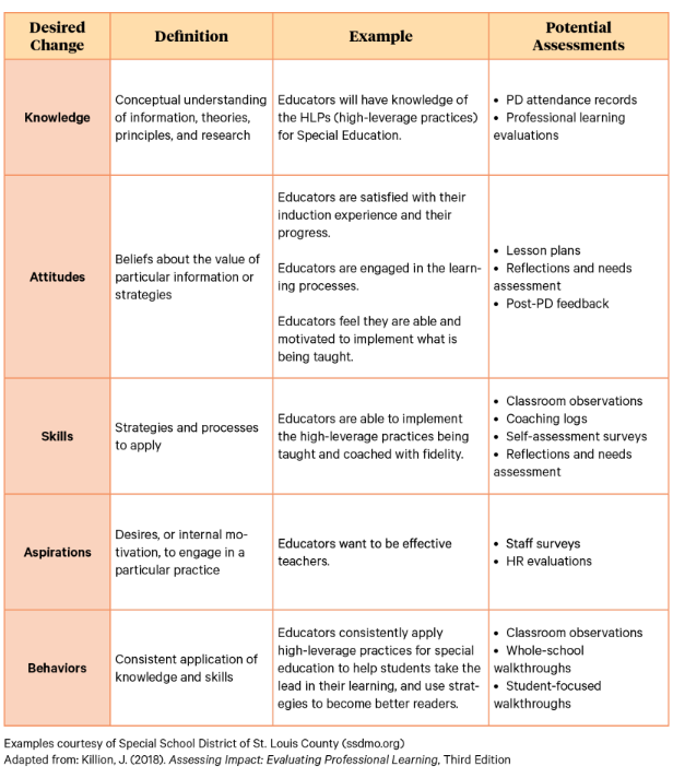
KASAB Tools, such as this Goals table, can help professional learning participants set their goals and determine the best way to evaluate progress.
Multiple Measures
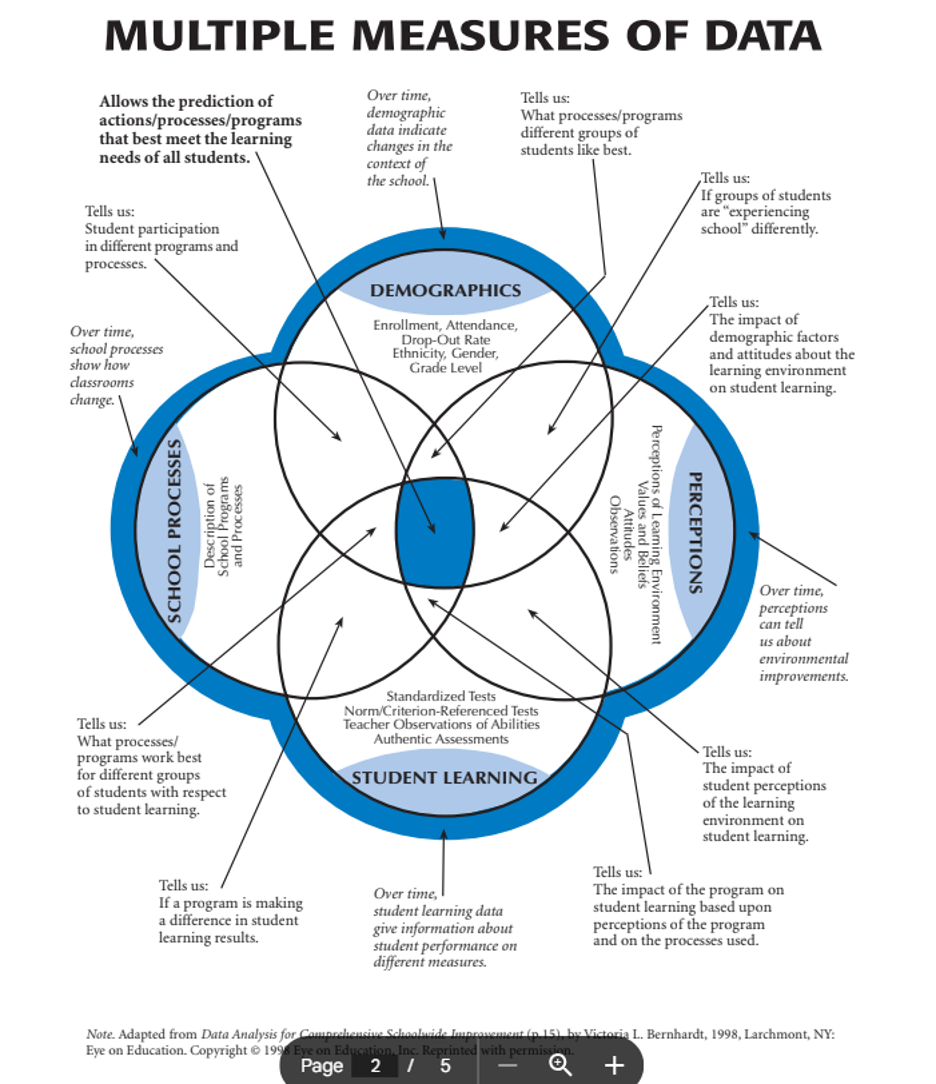
Paper by Victoria L. Bernhardt
The author makes the argument that analyses of demographics, perceptions, student learning, and school processes provide a powerful picture that will help us understand the school’s impact on student achievement. When used together, these measures give schools the information they need to improve teaching and learning to get positive results.
Video of the Month
ICYMI - OSEP-NASDSE Webinar Series for Potential SPDG Applicants
1st Webinar: Deep Family Engagement
Resources shared:
- Engaging Critical Perspectives tools from SISEP
- Leading by Convening rubrics
- Framework for Value Creation – “Learning to Make a Difference” (Etienne Wenger)
- Partnering with Families Through Special Education from the Ohio Statewide Engagement Center
If You Have the Time
READING REFORM ACROSS AMERICA:
Susan B. Neuman, New York University
Esther Quintero, Albert Shanker Institute
Kayla Reist, University of Virginia
JULY 2023
How Veteran Teachers Make Large Classes Feel Manageable | Edutopia