Archived newsletter — July 2023. This issue preserves historical information; events, contacts, and resources may have changed.
We are all in the business of providing for others’ needs. The trouble is the need can feel overwhelming and debilitating. Enough so that you are unsure of the next right step. The possibility of success can feel so unlikely that you’re not sure there is a right step.
At the SIGnetwork social hour I stood with two women who have been working in special education for the last 30 years. They’ve worked toward large-scale systemic change so that kids with disabilities would be equipped to live their best life. I’ve witnessed the good these women have done and the changes that have come about due to their smarts, strategic action, and persistence. But the problem was, they weren’t feeling it. They couldn’t see what I saw.
We’ve all felt this way before. When all you can see is the need and all you can feel is that you aren’t enough to meet it. You may have felt that way last month, last week, or just yesterday. And, there is no doubt this great need exists. But there is also great hope. When I looked around the room last Tuesday, I saw great thinkers and leaders. I saw people who were there to support each other and continue supporting each other. I saw hope.
We are fortunate to have SIGnetwork bring us and keep us together. My question to you is, can you build something similar for the people you support? A cohort, a learning community, peer mentors? What is possible? We know people need to feel seen and heard. How do you connect your people so they feel seen and heard and get to the business of doing their own good work?
Fortunately, our SIGnetwork social hour conversation did not end there. I reminded both women of the specific changes I had seen because of their work. I talked about what looked different because they had been there. Hopefully you can do the same for your people, because we could all use a little cheerleading right about now.
-Jennifer Coffey
News You Can Use
Upcoming Directors’ Webinar: Thursday, August 3rd from 3:00-4:30 on Zoom.
The topic is still fidelity! We heard good things about your fidelity conversations during the SPDG Program Area Meeting. We also received requests for more time. So our next Directors’ Webinar will be more time with our fidelity speakers, as well as a chance to share our major learnings from the OSEP Conference. Please come prepared to ask questions or send them to me in advance (Jennifer.Coffey@ed.gov).
If you do not have the meeting invitation for ongoing Directors’ Webinars, please ensure you are registered here.
The SPDG National Meeting will be in-person in DC October 17th & 18th at the Capital Turnaround. Please note the slight date change (originally October 18th & 19th). Our planning committee is developing the agenda. If you would like to buy your plane tickets please fly in on October 16th. October 18th will be a half-day, so an afternoon flight that day would work. Contact Jennifer Coffey with your questions (Jennifer.Coffey@ed.gov)
Funding Opportunities
Check out the latest open OSEP funding opportunities.
OSERS Funding Opportunities
Notice Inviting Applications for OSEP:—National Center for Supporting School Building and Early Intervention Program Administrators to Effectively Implement IDEA and Improve Systems Serving Children with Disabilities (Assistance Listing Number 84.325Z).
The purpose of this priority is to fund a cooperative agreement to establish and operate a National Center for Supporting School Building and Early Intervention Program (EIP) Administrators to Effectively Implement the Individuals with Disabilities Education Act (IDEA) and Improve Systems Serving Children with Disabilities (Center). The Center will help State educational agencies and Part C lead agencies effectively implement IDEA by building the capacity of school building and EIP administrators to meet the requirements of IDEA.
Deadline for Transmittal of Applications: Friday, August 18, 2023
Point of contact for the 84.325Z competition: Sarah Allen (Sarah.Allen@ed.gov)
Please find attached a PDF copy of the notice, which also is available online at FY23 NIA 84.325Z. The application package for the 84.325Z competition is posted on the Grants.gov website and also may be accessed on the Department’s website under New OSEP Grant Opportunities. Please share with others who may be interested.
SPDG Success!
SPDG Program Area Meeting Success!
A big thanks to our fidelity speakers and to YOU for making our time together useful and fun (why not enjoy the learning?). Our speakers were:
- Laura Barwegen
- Ann Jarratt
- Regina Pierce
- Stephanie Woodley
- Brent Garrett
- Christopher Miller
- Jeremiah Pope
- Amanda Working
- June Gothberg
- Pattie Noonan
- Melissa Towery
And huge gratitude to our small but mighty planning committee:
- Laura Barwegen
- Becky Jo Gerdes
- Kristen Perez-Rickels
- Annette Young
Improving Professional Learning
How-to Guide: Leveraging AI and Chat GPT: Advancing Our Work Through Technology from the Family Network on Disabilities (FND). Get fantastic ideas and concrete steps on using artificial intelligence to make your life easier. Here are examples from FND:
- Accessible Content: AI videos can make educational content more engaging and accessible. With text-to-speech and speech-to-text features, it ensures inclusivity for children with hearing or visual impairments. Animated AI videos can also be used to illustrate complex concepts, making them easier to understand.
- Intervention Tracking: AI tools can be used to monitor and track the progress of interventions. AI can analyze data on students’ performance and engagement, offering insights to educators and parents to better understand progress and make data-driven decisions.
- Communication and Support: Chatbots like GPT can provide 24/7 support to families, answering questions, providing information about services and rights, and serving as a tool for basic counseling. This can relieve some of the pressures from staff and provide families with immediate assistance whenever needed.
- Training and Professional Development: AI can simulate real-life scenarios and challenges, providing an interactive platform for educators to enhance their skills. It can also provide personalized learning paths for professional development.
- Community Building: AI can help in building an online community of educators, students, and parents, fostering a supportive network where experiences and best practices are shared.
Family Engagement Done Well
Improving School-Family Communication and Engagement: Lessons from Remote Schooling during the Pandemic. This brief from the University of Chicago Consortium on School Research outlines seven lessons from focus group participants.
Key Lessons
Lesson 1. Virtual meeting options provided more flexible scheduling opportunities for parents to communicate with educators
Lesson 2. Mobile apps increased timely communication between parents and educators
Lesson 3. Translation features in mobile apps allowed for direct communication between educators and parents who speak languages other than English
Lesson 4. Schools enlisted all staff members, including non-instructional staff, to serve as additional resources to help cultivate additional relationships between schools and parents
Lesson 5. Schools created inclusive, family-focused co-curricular events that helped deepen their relationships with parents
Lesson 6. Schools created virtual and in-person forums where parents connected with one another and deepened their sense of community
Lesson 7. Understanding students’ family and community contexts helped schools to reach—and know how to be reached by—families during the pandemic
Spotlight on OSEP/TA
How do you share your results? Are you attracting people to your data? Are they learning from it and taking action? OSEP’s Center to Improve Program and Project Performance (CIPP) recently released a product that will help you bring your data to life. We want to hear from you, let us know how you use this great information.
Our new Assistant Secretary, Glenna Gallo (formerly Special Education Director for the State of Washington), is on the lookout for our investments’ impact. One example of how to share your good work is through an impact story. The Department’s Comprehensive Centers have been kind enough to share strong examples with us here. What will your impact story look like?
Tweets, Podcasts, & Videos of the Month

The latest blog post from Ann Handley (last year’s keynote speaker) is an ode to Sinead O’Connor that demonstrates the impact storytelling can have on your reach and results. Seeing the difference storytelling can make may not be surprising, but it’s certainly a good reminder. Good stuff!
If You Have the Time
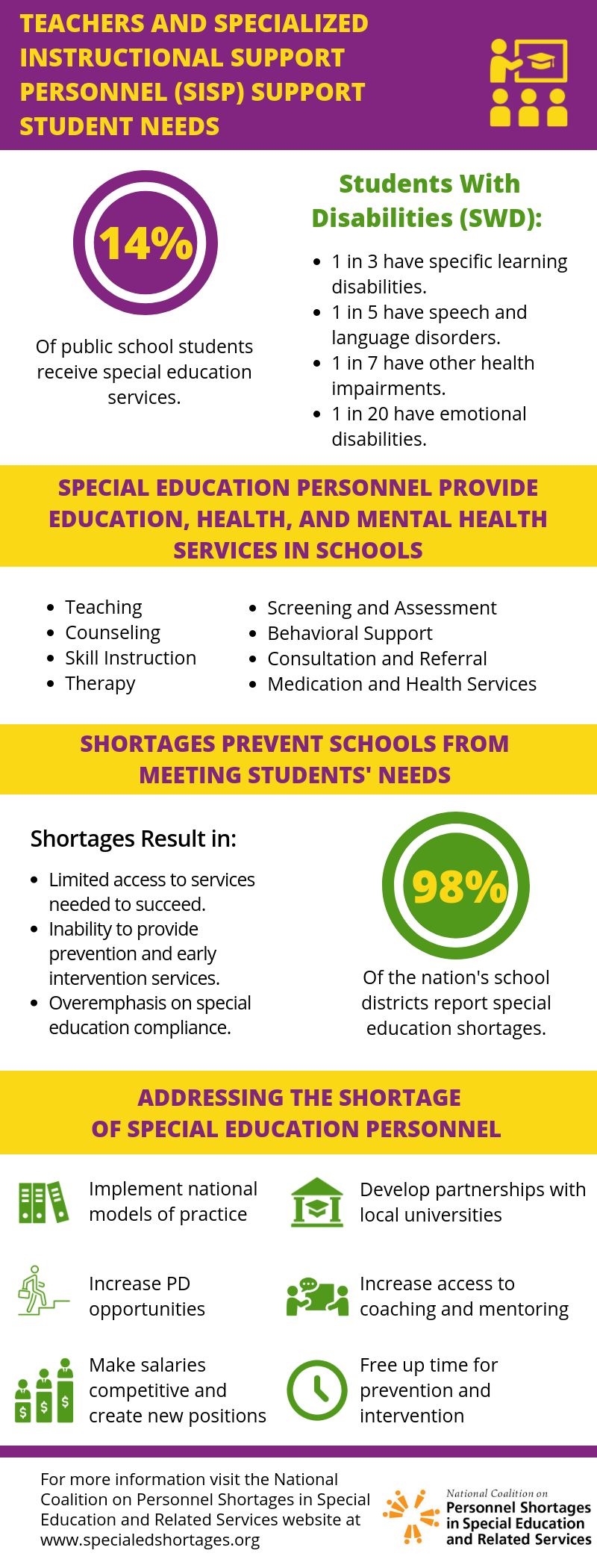
The National Coalition on Personnel Shortages in Special Education and Related Services’ (NCPSSERS) more than 30 participating member organizations are dedicated to addressing the issue of shortages in special education and related services personnel. Their infographic About the Shortage demonstrates the urgency of the situation and provides evidence-based strategies for responding to the shortage.